Platform selection depends entirely on lateral reach and overhead obstruction clearance. An articulating knuckle boom is engineered with jointed arm sections that pivot up and over roof overhangs, HVAC ducts, or…
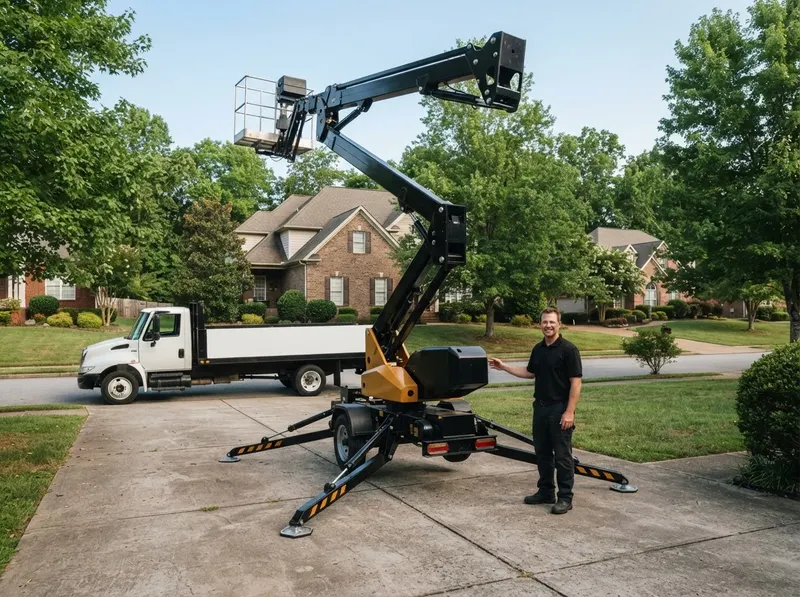
Platform selection depends entirely on lateral reach and overhead obstruction clearance. An articulating knuckle boom is engineered with jointed arm sections that pivot up and over roof overhangs, HVAC ducts, or historical St. Elmo porch eaves, granting horizontal outreach up to 30 feet from a compact base. In contrast, a straight telescopic boom drives a single extendable arm directly into vertical space, which suits wide-open exterior siding, steel erection, or commercial glass installation along Market Street in the Southside Historic District where reach distance overrides clearance obstacles. The primary operational trade-off is machine footprint versus maneuverability: articulating models offer tighter turning radiuses inside industrial bays along Amnicola Highway, while straight booms require wider staging clearances but deliver superior working height beyond 60 feet.
Site topography in Hamilton County dictates transport logistics and running-gear selection. Navigating a 20-ton roll-back trailer onto narrow residential corridors in Northshore, steep hillside grades near Mountain Creek Road, or the winding access points below Lookout Mountain demands pre-route verification. Steep driveways exceed standard electric wheel-motor traction, requiring four-wheel-drive rough-terrain diesel units equipped with oscillating front axles and foam-filled lug tires to maintain stability on loose red clay or sloped aggregate. For indoor warehouse maintenance in Brainerd or East Brainerd, non-marking solid rubber tires and zero-emission electric battery packs are non-negotiable to prevent concrete floor damage and interior air contamination.
Project staging follows three rigid steps to maintain strict site safety. First, an overhead hazard assessment maps power lines and tree canopies, maintaining a 10-foot minimum boundary from all active electrical conductors as mandated by OSHA standards. Second, the transport carrier offloads the boom onto compacted asphalt, concrete, or engineered ground-support timber mats to prevent subsurface hydraulic collapse on saturated sod. Third, the ground operator runs a complete pre-shift inspection, confirming ground-control and basket-control overrides, limit switches, and harness anchor points before the basket leaves zero elevation.
Every job gets a firm, written price after a free on-site visit.
Tell us about your boom lift rentals job in Chattanooga and we'll send a clear, written quote, usually the same day.
 ClearOut Dumpster Rental